


“FIL MRD Network” is a network of laboratories that collaborates for the realization of the minimal residual disease (MRD) studies related to the FIL trials.
The biological samples (peripheral blood and bone marrow) of clinical trials patients are centralized in the laboratories of the Network, where they carry out analyses.
Today, this network has 4 laboratories which cover all the geographical areas of the national territory.
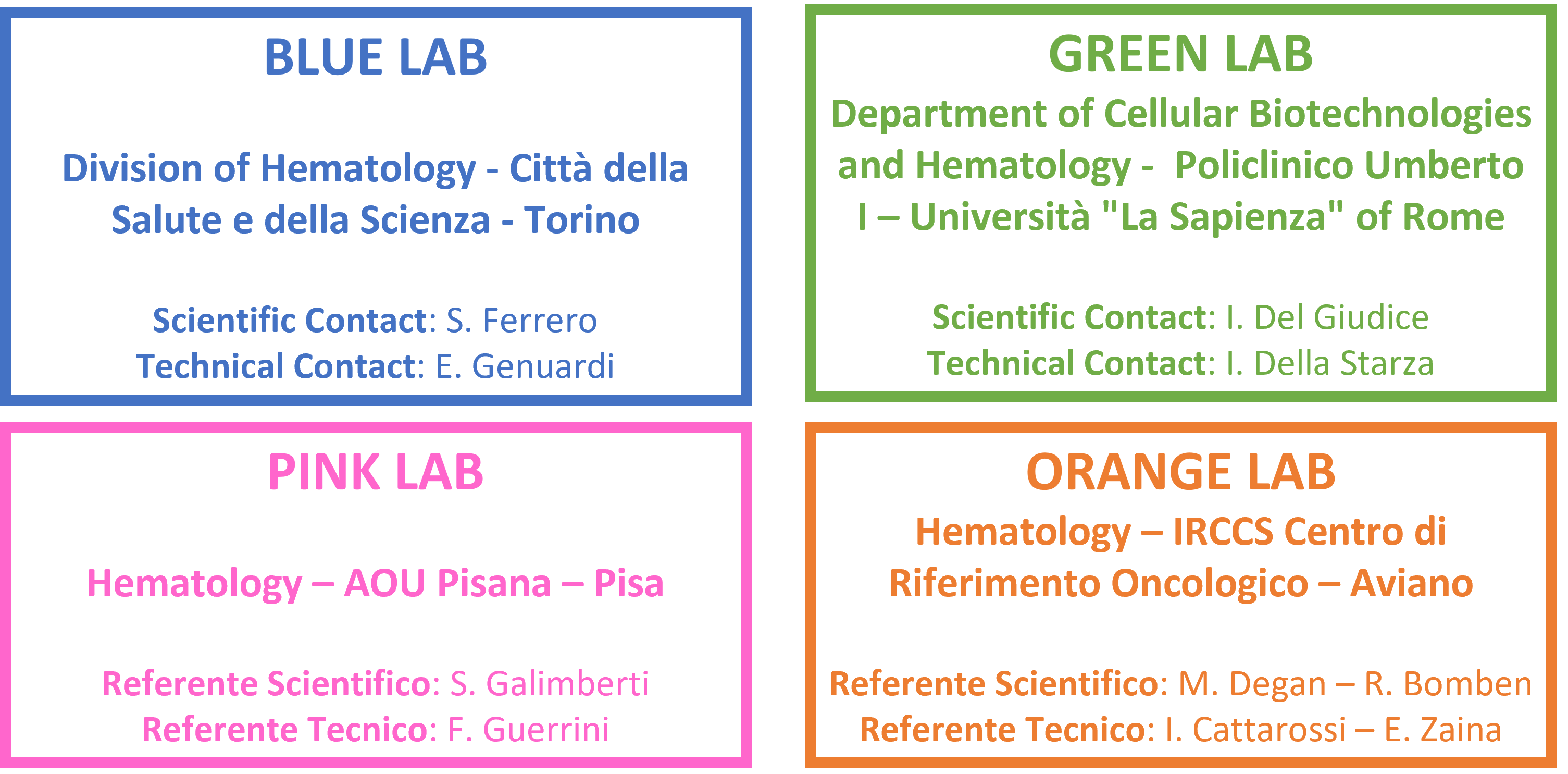
“FIL MRD Network” is fundamental to:
- Develop and encourage the management of MRD studies integrated into clinical trials;
- Conduct periodic quality checks (biannual), which ensure the standardization of MRD assessment techniques in lymphomas, so the reproducibility of results between laboratories;
- Build a national biobank;
- Promote the integration of biological elements and of “Precision Medicine” in the area of the FIL clinical studies.
Over the last three years (2015-2017), the samples of over 780 patients with follicular lymphoma enrolled in four FIL prospective trials (FOLL12, FLAZ12, RENOIR12, MIRO’) were centralized.
Particularly, in the studies FOLL12 and MIRO’ the MRD results are used in “real time” to address patients to different personalised therapies.
MRD analyses are used in another studies, such as R2B, MCL0208, RBAC500 and TRIANGLE (mantle cell lymphoma); BRB (Waldenstrom macroglobulinemia).
Since 2018, the MRD analyses have used in two other studies: RI-CHOP (diffuse large-cell lymphoma B) and V-RBAC (mantle cell lymphoma).
In 2018 the FIL MRD network laboratories joined the EuroMRD Consortium European group for the standardization of the MRD analysis for lymphomas.
The EuroMRD Consortium is a division of the ESLHO (European Scientific Foundation for Laboratory HematoOncology), in turn the EHA‘s official scientific working group (EHA Scientific Working Group, SWG).